
Is it normal for a boiler to make noise?
Yes. Every boiler makes some sound when it ignites, heats water and pumps it round the system: usually a soft whoosh on ignition and a low hum while running. The warning sign is change: a noise that is new, louder than before, more frequent, or that comes with other symptoms such as pressure loss, leaks or cold radiators.
Banging or rumbling: often kettling
Kettling is the most common cause of a banging boiler we see in London. Limescale or sludge builds up on the heat exchanger, so water passing over it overheats in spots, boils and forms steam bubbles. The collapsing bubbles make a rumbling, popping or banging sound, like a kettle coming to the boil.
London’s hard water makes this more likely, particularly on older systems without a magnetic filter or scale protection. Left alone, kettling reduces efficiency, strains the heat exchanger and can lead to the boiler locking out or the heat exchanger failing.
Banging can also come from the pipework rather than the boiler (water hammer), or from a pump that has failed or is set incorrectly. An engineer can tell which.
Typical fixes: descaling or flushing the heat exchanger, a system powerflush (/powerflushing/) or chemical clean, fitting a magnetic filter and refreshing the inhibitor. If the heat exchanger is badly damaged on an older boiler, replacement may be better value.
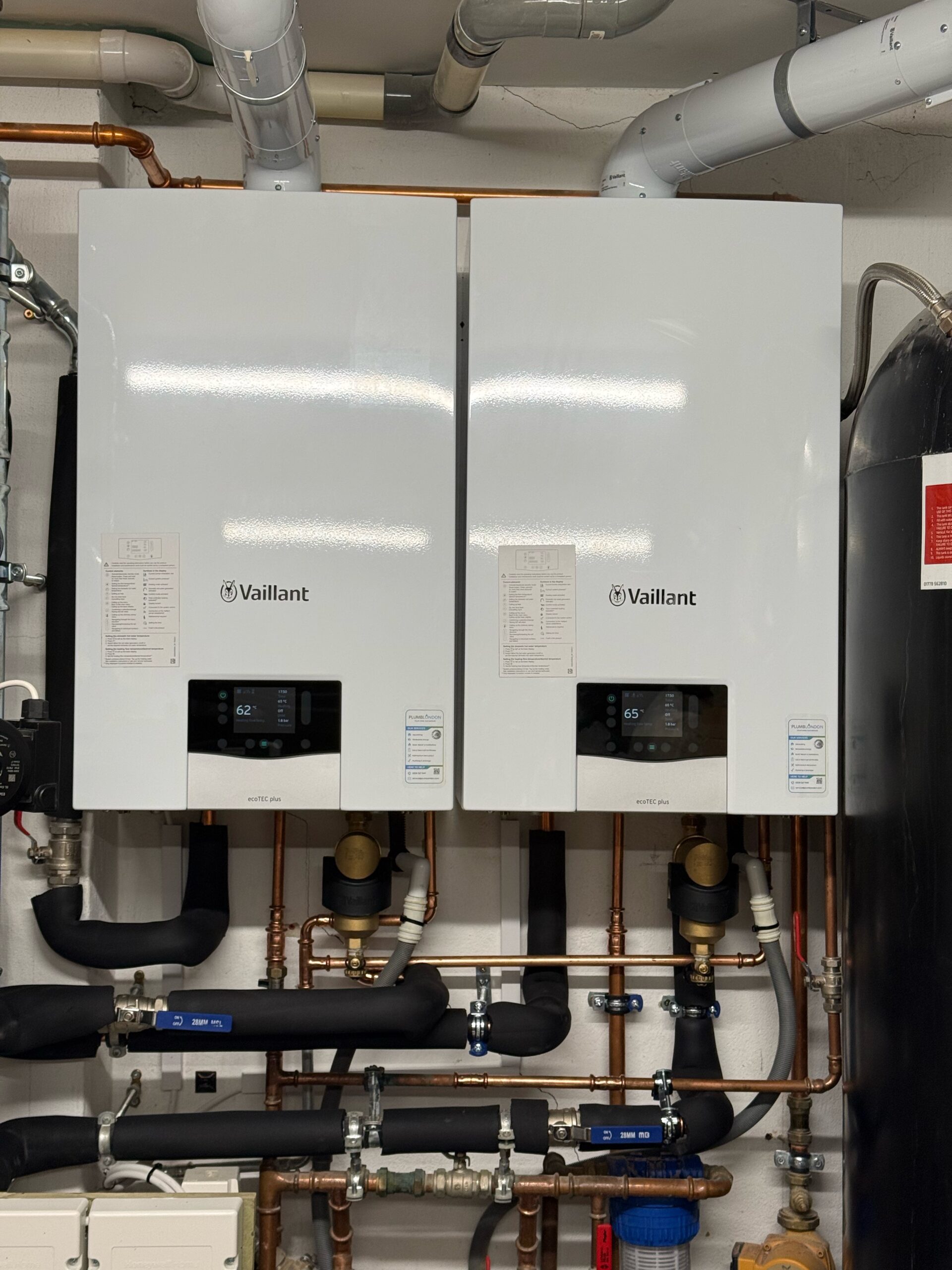
Real example: kettling found on a routine service at Balmain, Mayfair
During an annual service at Balmain’s Mayfair premises, Mo, our senior commercial Gas Safe engineer, found the Vaillant ecoTEC plus 824 was showing signs of strain and had started to kettle. The boiler was tested and confirmed safe. Because the kettling was age-related rather than a one-off fault, Mo recommended planning a replacement in the near future, before the boiler fails.
The boiler was still heating, so there was no obvious reason to call anyone. The service picked up the warning signs, giving the client time to plan a replacement on their terms rather than deal with an emergency breakdown.
Read the full case study
Other noises to look out for:
Whistling – A whistle that sounds like a kettle is often the same problem: kettling caused by scale or sludge restricting flow through the heat exchanger. Trapped air and partly closed valves can also cause it. If the whistle is new or happens every time the heating fires, book a check.
Hissing – Can be kettling, but it can also mean water is escaping: a leak inside the boiler, or the pressure relief valve discharging because system pressure is too high. Look for water under the boiler and at the small copper pipe that runs outside. If you find a leak, turn the boiler off and arrange a same-day repair.
Gurgling – Usually means air in the system or low water pressure. Radiators that are cold at the top are a strong clue, and bleeding them often solves it. Check the pressure gauge afterwards: most sealed systems sit around 1 to 1.5 bar when cold (check your boiler’s manual).
In freezing weather, gurgling followed by the boiler stopping is often a frozen condensate pipe. Pouring warm (not boiling) water along the outside section usually clears it, then reset the boiler.
Loud whooshing or roaring – A soft whoosh on ignition is normal. A loud roar, or a whoosh that has got noticeably louder, can point to a fan problem, delayed ignition, a partly blocked flue or a heavily scaled heat exchanger. Don’t investigate inside the boiler. Note when it happens and book an engineer.
Rattling, vibrating or buzzing – Sometimes it is simple: a loose casing panel or pipe clip vibrating against a wall. Persistent rattling or humming from inside the boiler can also be a worn pump or fan bearing. Both are repairable, but a failing pump can stop the boiler entirely if left.
Any change from the usual sound – You know how your boiler normally sounds. If it is louder, slower to start, switching on and off more often, or making a sound you haven’t heard before, treat that as an early warning. Many faults start quietly.
Repair, service or replace?
- Service: the boiler works but sounds different, or it hasn’t been serviced in over 12 months. A service is often where problems like kettling are first caught. Book a boiler service
- Repair: there is a clear fault, such as a leak, lockouts, persistent banging or pressure loss. Book a boiler repair
- Replace: the boiler is older, repairs are becoming frequent, or a major part such as the heat exchanger has failed. Boiler installation options
Frequently asked questions
What is boiler kettling? Kettling is when limescale or sludge on the heat exchanger makes water overheat and boil in spots, causing a rumbling or banging noise. It is common in hard-water areas like London and is usually fixed by descaling, flushing or replacing the heat exchanger.
Is a noisy boiler dangerous? Most noisy boilers are not immediately dangerous, but the noise usually signals a fault that will get worse. If you smell gas, see scorch marks or the flame looks yellow or orange instead of blue, turn the boiler off and call 0800 111 999.
Can I keep using a boiler that is banging? It may keep working for a while, but kettling strains the heat exchanger and cuts efficiency. Book an engineer rather than waiting for a breakdown.
Why does my boiler gurgle when the heating comes on? Usually air in the system or low pressure. Bleed your radiators and top up the pressure if it is low. In freezing weather, check the condensate pipe hasn’t frozen.
Will a powerflush stop my boiler kettling? Often, if the cause is sludge or scale in the system. If the heat exchanger itself is heavily scaled or damaged, it may need descaling or replacing too. An engineer can confirm which.
Can an annual service prevent boiler noises? A service won’t stop every fault, but it is where early signs like kettling, worn pumps and pressure problems are usually found, before they cause a breakdown.
Do you cover my area? We cover London, including Mayfair, Westminster, Kensington and Chelsea. See the areas we cover
Boiler making noises? Speak to a London heating engineer
Our Gas Safe registered engineers will find the cause, explain it clearly and tell you whether it needs a simple repair, a service or a conversation about replacement. We work in homes, landlords’ properties and commercial premises across London.